


You’re selling online. Someone lands on your product page. They either buy once… or they stick around and keep paying you every month.
That one decision changes everything.
Most eCommerce stores still rely heavily on one-time purchases. A customer comes in, buys, disappears. You spend again on ads to bring the next one in. It works, but it’s unpredictable. Some months feel great. Some don’t.
Subscriptions flip that.
Instead of chasing every sale, you build a base of customers who keep coming back automatically. You know what’s coming next month. You can plan inventory, cash flow, even marketing with a bit more confidence.
And this shift isn’t small.
Subscription businesses have grown 435% over the past decade, and customers on subscriptions generate 3 to 5x more revenue over their lifetime compared to one-time buyers. (Swell)
That’s not a tiny improvement. That’s a completely different business model.
Still, one-time purchases aren’t going anywhere. They’re simple. Low commitment. Easy for new customers to say yes to.
So now you’ve got a real decision to make.
Do you stick with one-time sales and keep things simple? Or do you add subscriptions and build predictable revenue over time?
Most brands don’t pick one. They mix both. But the balance matters. For Shopify merchants, combining one-time purchases with recurring subscriptions is much easier using apps like Utterbond Subscriptions that support recurring billing, flexible subscription plans, and customer self-management directly inside Shopify.
That’s exactly what we’re breaking down next. In this article, we will cover main differences between Subscription Vs One-Time Payment, a detailed comparison table to choose the best one for your business, and a guide on technical implementation for WooCommerce store owners.
Table Of Contents
Main Differences Between Subscription Vs One-Time Payment
At a glance, both models look similar. A customer pays, you deliver a product, end of story.
But once you run a store, the difference shows up everywhere. Cash flow, customer behavior, even how you plan your next month.
- With one-time purchases, revenue is unpredictable. You get spikes when campaigns work, then quiet periods where sales slow down. You’re always working to bring the next customer in. Subscriptions feel different. Each new subscriber adds to a base that carries forward. Over time, that base starts covering a chunk of your monthly revenue on its own.
- The customer relationship also shifts. One-time buyers treat the purchase like a quick transaction. They come in, buy, and leave. Subscribers stick around. They expect consistency. If the experience drops, they don’t complain much, they cancel.
- Money per customer changes too. A one-time buyer might spend ₹500 once and disappear. A subscriber paying ₹500 every month for 6 months brings in ₹3,000. Same product, completely different outcome.
- There’s also a difference in how easy it is to get that first “yes.” One-time purchases are low commitment. Quick decision. Subscriptions ask for trust because the customer knows they’ll be charged again. That extra friction is real.
- On the backend, things start to feel more stable with subscriptions. You can roughly estimate how many orders are coming next cycle. Inventory planning gets easier. With one-time sales, you’re often reacting instead of planning.
- Marketing changes as well. One-time models push you toward constant acquisition. Ads, offers, repeat. Subscription business models force you to care about retention. Onboarding, engagement, reducing churn.
Side-by-Side Comparison of Subscription Vs One-Time Payment
Here’s how both models stack up when you put them in the same frame:
| Factor | Subscription | One-Time Model |
|---|---|---|
| Revenue flow | Recurring, builds month over month | One-off, resets after every sale |
| Cash flow predictability | More stable, easier to forecast | Unpredictable, depends on constant sales |
| Customer relationship | Ongoing, long-term engagement | Short-term, transactional |
| Customer lifetime value | Higher, it grows over time | Limited to single or occasional purchases |
| Conversion difficulty | Harder, requires trust upfront | Easier, low-commitment decision |
| Retention focus | Critical, churn directly impacts revenue | Secondary, focus stays on new customers |
| Inventory planning | More predictable based on active subscribers | Fluctuates, harder to estimate demand |
| Marketing strategy | Retention + lifecycle marketing | Heavy on acquisition and promotions |
| Customer Control | Needs pause, skip, and cancel options | Full control, buy anytime |
| Risk Factor | Higher churn risk if experience drops | Lower ongoing risk after purchase |
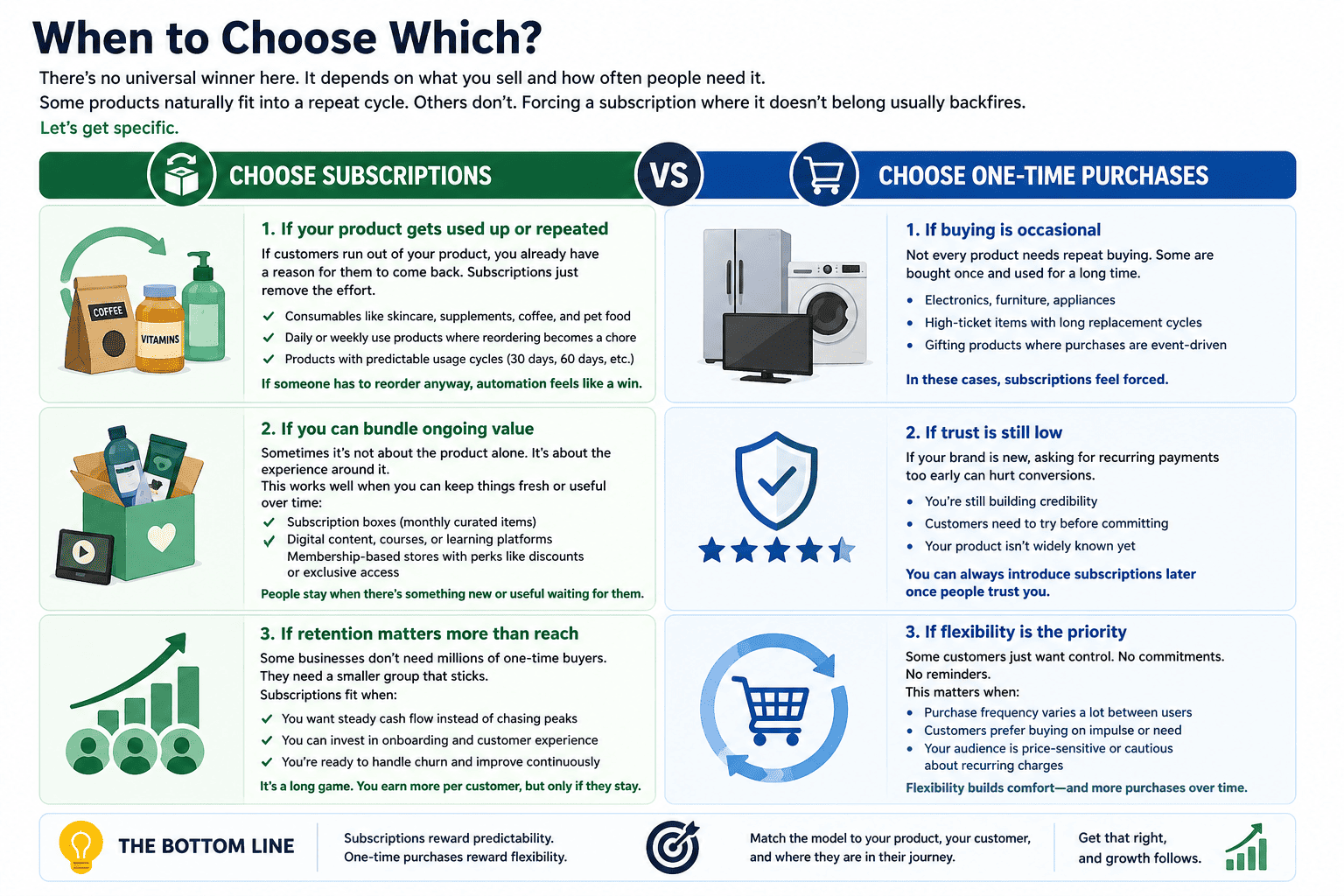
When to Choose Which?
There’s no universal winner here. It depends on what you sell and how often people need it.
Some products naturally fit into a repeat cycle. Others don’t. Forcing a subscription where it doesn’t belong usually backfires.
Let’s get specific.
1. Choose subscriptions if your product gets used up or repeated
If customers run out of your product, you already have a reason for them to come back. Subscriptions just remove the effort.
Think:
- Consumables like skincare, supplements, coffee, and pet food
- Daily or weekly use of products where reordering becomes a chore
- Products with predictable usage cycles (30 days, 60 days, etc.)
If someone has to reorder anyway, automation feels like a win.
2. Choose subscriptions if you can bundle ongoing value
Sometimes it’s not about the product alone. It’s about the experience around it.
This works well when you can keep things fresh or useful over time:
- Subscription boxes (monthly curated items)
- Digital content, courses, or learning platforms
- Membership-based stores with perks like discounts or exclusive access
People stay when there’s something new or useful waiting for them.
3. Choose subscriptions if retention matters more than reach
Some businesses don’t need millions of one-time buyers. They need a smaller group that sticks.
Subscriptions fit when:
- You want a steady cash flow instead of chasing peaks
- You can invest in onboarding and customer experience
- You’re ready to handle churn and improve continuously
It’s a long game. You earn more per customer, but only if they stay.
4. Choose one-time purchases if buying is occasional
Not every product needs repeat buying. Some are bought once and used for a long time.
In these cases, subscriptions feel forced:
- Electronics, furniture, appliances
- High-ticket items with long replacement cycles
- Gifting products where purchases are event-driven
5. Choose one-time purchases if trust is still low
If your brand is new, asking for recurring payments too early can hurt conversions.
One-time purchases work better when:
- You’re still building credibility
- Customers need to try before committing
- Your product isn’t widely known yet
You can always introduce subscriptions later once people trust you.
6. Choose one-time purchases if flexibility is the priority
Some customers just want control. No commitments. No reminders.
This matters when:
- Purchase frequency varies a lot between users
- Customers prefer buying on impulse or need
- Your audience is price-sensitive or cautious about recurring charges
How to Implement a Subscription Model on Your eCommerce Store
Now the main question arises: with a one-time revenue model, things are quite easy; all you have to do is set up an eCommerce store. But with the subscription business model, things get a bit tricky; you have to manage recurring payments and renewal dates, while also keeping track of customer data and churn rates.
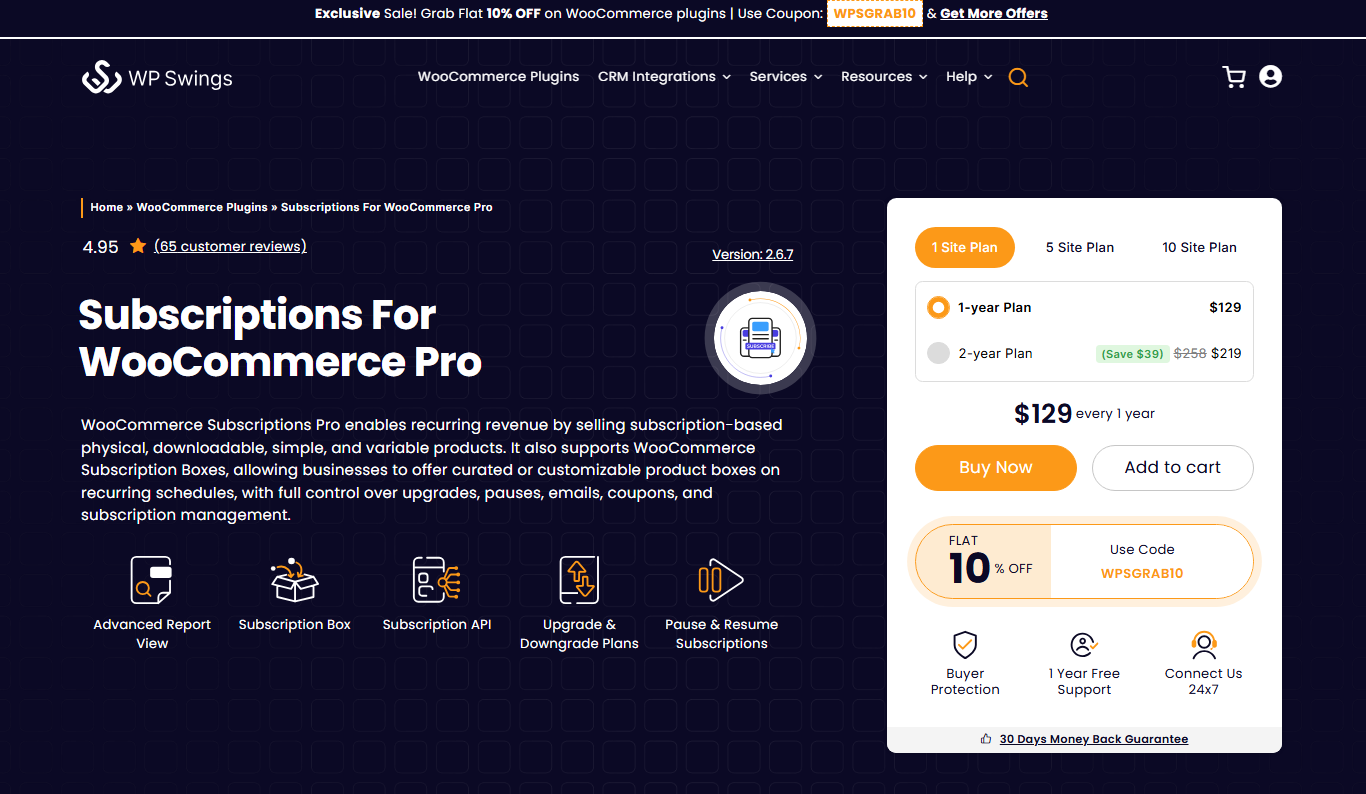
Well, we have something that may help you. If you are a WooCommerce store owner, you can use the WooCommerce subscription plugin to automate nearly everything your store needs to run a subscription program successfully.
Let’s see how to set this up.
How to Setup Subscription Plugin by WP Swings
After installing and activating the plugin
-
- Go to “Products” and click on “Add New” in your WooCommerce dashboard.
- Enter the product name and select “Simple Subscription” from the product data drop-down menu.
- Set the subscription price and billing cycle for your product according to your business model.
- Configure the subscription expiry date and add signup fees if required.
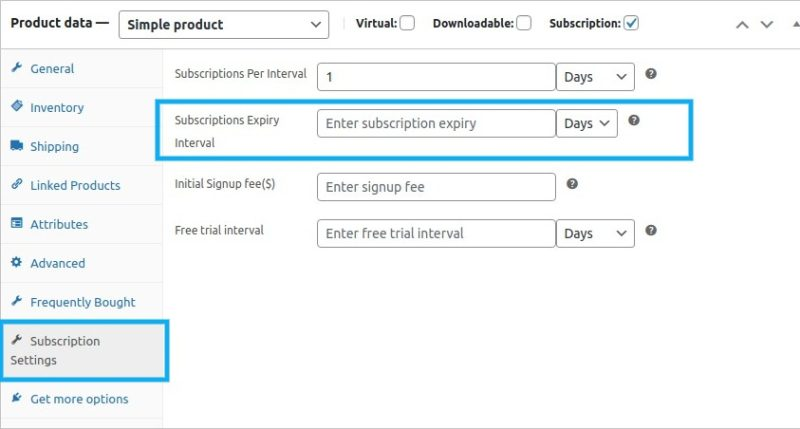
- Offer a free trial period for subscription products and set the trial duration in days, weeks, months, or years.
- Add a product image by clicking on “Set Product Image” to improve the product presentation.
- Click on “Publish” to make your subscription product live on your WooCommerce store.
Major Features of Subscription Plugin by WP Swings
- Automatic Retrying for Failed Payments
- Subscriptions One-Time Purchase
- Create Manual Subscription Order
- Compatible With Multiple Payment Gateways
- Feature to Offer Subscription Box to Customers
- Option to Cancel Subscription Anytime by Customer or Admin
- Dedicated Subscription Dashboard for Detailed Reports
- Offer a Free Trial to Your Customers
- Rest API of Subscription Details to Connect it With External Applications
Start Your Recurring Revenue Stream With The Subscription Model
Conclusion
At the end of the day, this is not really a battle between Subscription Vs One-Time Payment. Both models solve different problems.
One-time purchases make it easier to attract customers quickly. They work well for products people buy occasionally or when your brand is still building trust. The buying decision is simple, fast, and low commitment.
Subscriptions, on the other hand, are built for long-term growth. They help you create predictable revenue, increase customer lifetime value, and build strong relationships with customers over time. Instead of starting from zero every month, you grow a recurring customer base that keeps your business moving forward.
For most eCommerce brands, the smartest approach is not choosing one over the other. It is combining both strategically.
You can use one-time purchases to bring customers in and subscriptions to keep them engaged for the long run. Many successful brands follow this exact model because it balances customer acquisition with recurring revenue.
And if you run a WooCommerce store, setting this up is much easier than it used to be. With the Subscription for WooCommerce plugin by WP Swings, you can manage recurring billing, trials, renewals, cancellations, subscription boxes, and customer subscriptions without dealing with the technical complexity manually.
Grow Your Subscription Store This Festive Season
Frequently Asked Questions (FAQ’s)
1. One‑time payment vs. subscription: what actually makes more money?
Over time, subscriptions usually generate more revenue per customer than one‑time payments, but they can be harder to acquire and are more sensitive to churn.
2. Can a subscription be a one‑time payment?
Yes. In WooCommerce, a “subscription” can be configured as a one‑time payment, so the customer pays once and then the access or benefit ends automatically, instead of renewing.
For example, the WP Swings Subscriptions for WooCommerce plugin has a “one‑time subscription” feature that lets you set a single‑charge subscription price for products or variations; customers pay once, and the order behaves like a subscription without recurring billing
3. What is the subscription trap?
A “subscription trap” is a deceptive or unclear way of enrolling customers into a paid subscription, often making it hard to cancel or hiding the recurring cost
4. How do customer retention rates compare between subscription and one‑time payment ecommerce models?
Subscribers generally have higher retention and longer‑term value than one‑time payment customers.
5. Can I switch my ecommerce store from one‑time payment to subscription billing easily?
Yes, you can usually switch an existing ecommerce store from one‑time to subscription billing, but the ease of doing so depends on your platform, plugins, and product design.
Do share your thoughts in the comment section. If you have any questions that are not mentioned in the FAQs, you can ask them in the comments, and we’ll make sure to answer every one of them!
About the Author: Mohd Talib





Some truly nice stuff on this site, I love it.
It’s interesting to see how much more predictable recurring revenue can be. I’ve found that building a strong relationship with subscribers leads to better long-term sales.