


Digital wallets capture 53% of global online purchases.
We know that by seeing the above stats, it is undeniable that digital wallets capture 50% of the market for the global digital wallet. eCommerce businesses are heavily relying on digital wallets and their unique features, such as store credit, cashback wallets, prepaid balances, and internal currency.
However, with this increased reliance also comes the risk of fraudulent activities on your store, because wallets are a high-value target for fraud, such as scammers creating fake accounts, hackers doing account takeovers, payment fraud, and promotional abuse.
Key Takeaways
- KYC verifies customer identities and helps ensure only legitimate users can access wallet features.
- eCommerce wallets are common fraud targets, making identity verification essential for security.
- KYC helps prevent fake accounts, synthetic identities, and promotional abuse by fraudsters.
- Account takeover attacks and payment fraud can be reduced through identity verification and secure account recovery.
- Businesses can lower chargebacks and fraud-related losses by restricting wallet access to verified users.
- Customer trust improves when wallets are protected, leading to higher confidence and long-term loyalty.
- WooCommerce stores can easily add KYC-enabled wallets using the Wallet System for WooCommerce plugin by WP Swings.
If you are an eCommerce store owner, this could be very stressful to constantly worry if the users on your platform are actually safe from fraudulent activity. The problem goes one step further, that the users on your platform are actual customers or just bots disguised as users performing random activities.
Here comes the solution,
Wallet KYC: Adding a KYC feature to your eCommerce wallet system significantly reduces fraud, synthetic identity theft, chargebacks, and account takeovers in the market.
In this article, we will go deep into why KYC is needed for eCommerce wallets, how KYC protects digitwallet systems, and how to implement KYC step-by-step for eCommerce/WooCommerce Stores.
Table Of Contents
What Is KYC and Why Does It Matter for Wallet Systems?
KYC stands for Know Your Customer. It’s a process to verify your customers’ identity using government-issued documents such as a driver’s license, state ID, passport.
KYC Verification protects your store’s wallet system by confirming that sign-ups are real, which can help prevent fraud. This is also a good way to comply with the regulatory expectations of FinCEN, AML, CIP, and MSB.
In a wallet system, KYC verification works in such a way that the user cannot make a transaction or utilize the full functionality of the digital wallet system without verifying their KYC details.
Wallet systems come with high-risk because the funds are instantly usable, the amount is hard to trace once moved, and fraudsters prefer wallets over direct card charges.
That’s why the need for KYC integration in a digital wallet system is getting more important day by day.
Why Do eCommerce Wallets Need KYC Now?
Ecommerce wallets need KYC due to various reasons, but 2 reasons are the most prominent: increasing fraudulent activities and the increasing awareness among shoppers about identity theft and payment fraud.
Below are 2 reasons, written in greater depth for your understanding.
1. Fraud Is Rising in eCommerce
Synthetic identity fraud is one of the fastest-growing fraud types in the US. As a result, account takeover attacks are increasing due to credential leaks and password reuse.
Most attackers commit payment fraud using stolen cards to load wallet balances, which are pretty hard to track. They use them for promotional abuse, which includes exploiting sign-up bonuses and cashbacks
Implementing Wallet KYC can help businesses combat these threats by verifying users’ identities before granting access to wallet features.
KYC makes it much harder for fraudsters to create fake accounts, abuse promotional offers, or operate multiple accounts using synthetic identities.
2. Trust as a Competitive Advantage
Implementing Wallet KYC demonstrates that your business takes payment security seriously. It sends a clear message to customers that you verify real identities, actively prevent fraud, and are committed to protecting their funds and personal information. Trust has become a major factor in online shopping decisions.
With identity theft, payment fraud, and data breaches making headlines regularly, consumers are more cautious than ever about where they spend their money and store their financial information.
This additional layer of security helps create a safer shopping experience and reassures customers that their wallet balances and transactions are protected. As a result, customers are more likely to trust your store and keep funds in their digital wallets.
How Does KYC Protect Your eCommerce Wallet System?
As digital wallets become more popular in eCommerce, they also become attractive targets for fraudsters.
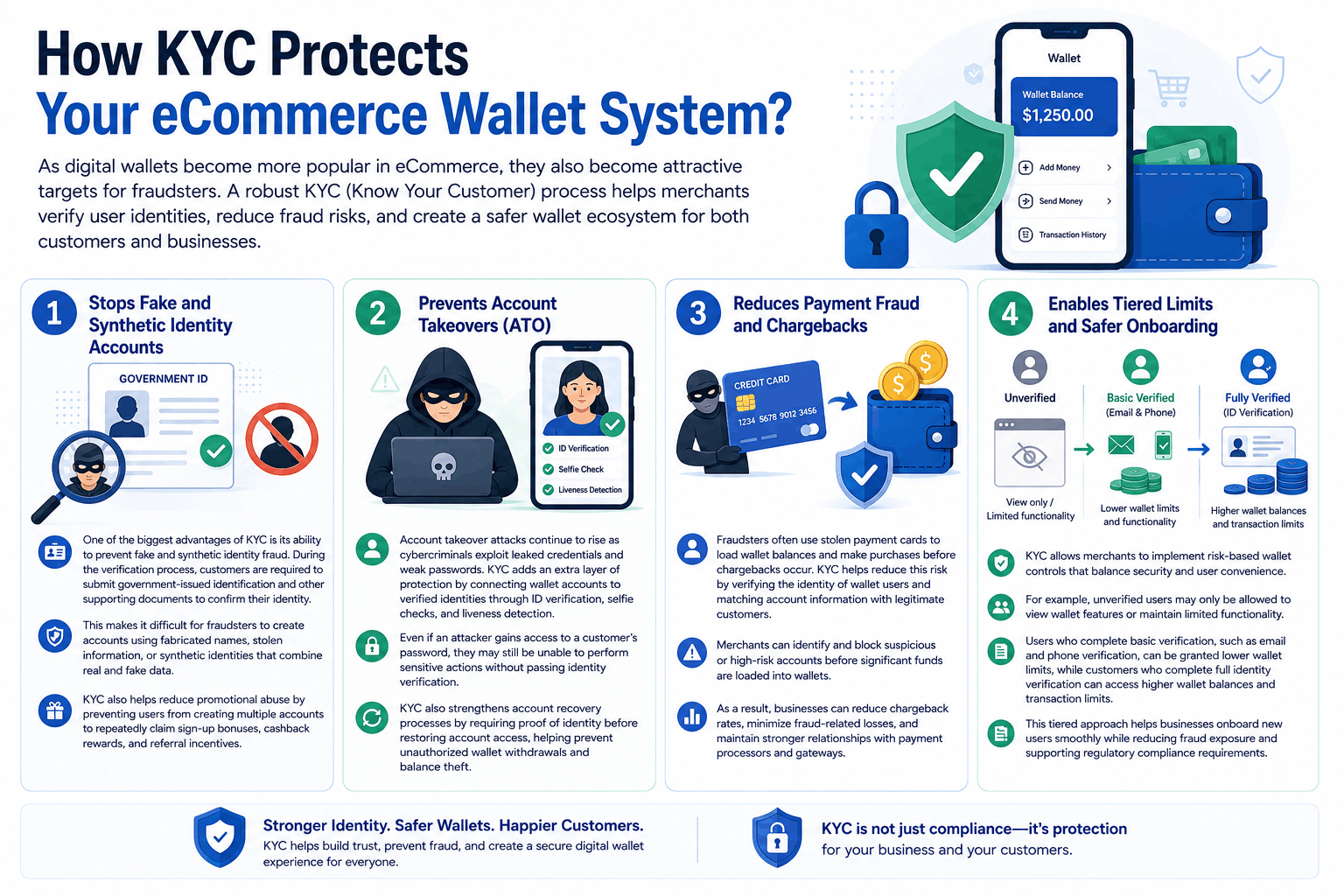
A robust KYC (Know Your Customer) process helps merchants verify user identities, reduce fraud risks, and create a safer wallet ecosystem for both customers and businesses.
1. Stops Fake and Synthetic Identity Accounts
One of the biggest advantages of KYC is its ability to prevent fake and synthetic identity fraud. During the verification process, customers are required to submit government-issued identification and other supporting documents to confirm their identity.
This makes it difficult for fraudsters to create accounts using fabricated names, stolen information, or synthetic identities that combine real and fake data.
KYC also helps reduce promotional abuse by preventing users from creating multiple accounts to repeatedly claim sign-up bonuses, cashback rewards, and referral incentives.
2. Prevents Account Takeovers (ATO)
Account takeover attacks continue to rise as cybercriminals exploit leaked credentials and weak passwords. KYC adds an extra layer of protection by connecting wallet accounts to verified identities through ID verification, selfie checks, and liveness detection.
Even if an attacker gains access to a customer’s password, they may still be unable to perform sensitive actions without passing identity verification.
KYC also strengthens account recovery processes by requiring proof of identity before restoring account access, helping prevent unauthorized wallet withdrawals and balance theft.
3. Reduces Payment Fraud and Chargebacks
Fraudsters often use stolen payment cards to load wallet balances and make purchases before chargebacks occur. KYC helps reduce this risk by verifying the identity of wallet users and matching account information with legitimate customers.
Merchants can identify and block suspicious or high-risk accounts before significant funds are loaded into wallets.
As a result, businesses can reduce chargeback rates, minimize fraud-related losses, and maintain stronger relationships with payment processors and gateways.
4. Enables Tiered Limits and Safer Onboarding
KYC allows merchants to implement risk-based wallet controls that balance security and user convenience.
For example, unverified users may only be allowed to view wallet features or maintain limited functionality.
Users who complete basic verification, such as email and phone verification, can be granted lower wallet limits, while customers who complete full identity verification can access higher wallet balances and transaction limits.
This tiered approach helps businesses onboard new users smoothly while reducing fraud exposure and supporting regulatory compliance requirements.
How to Add KYC Feature to Your eCommerce Wallet?
To add KYC functionality to your ecommerce wallet, you can utilize multiple existing extensions available for both Shopify and WooCommerce.
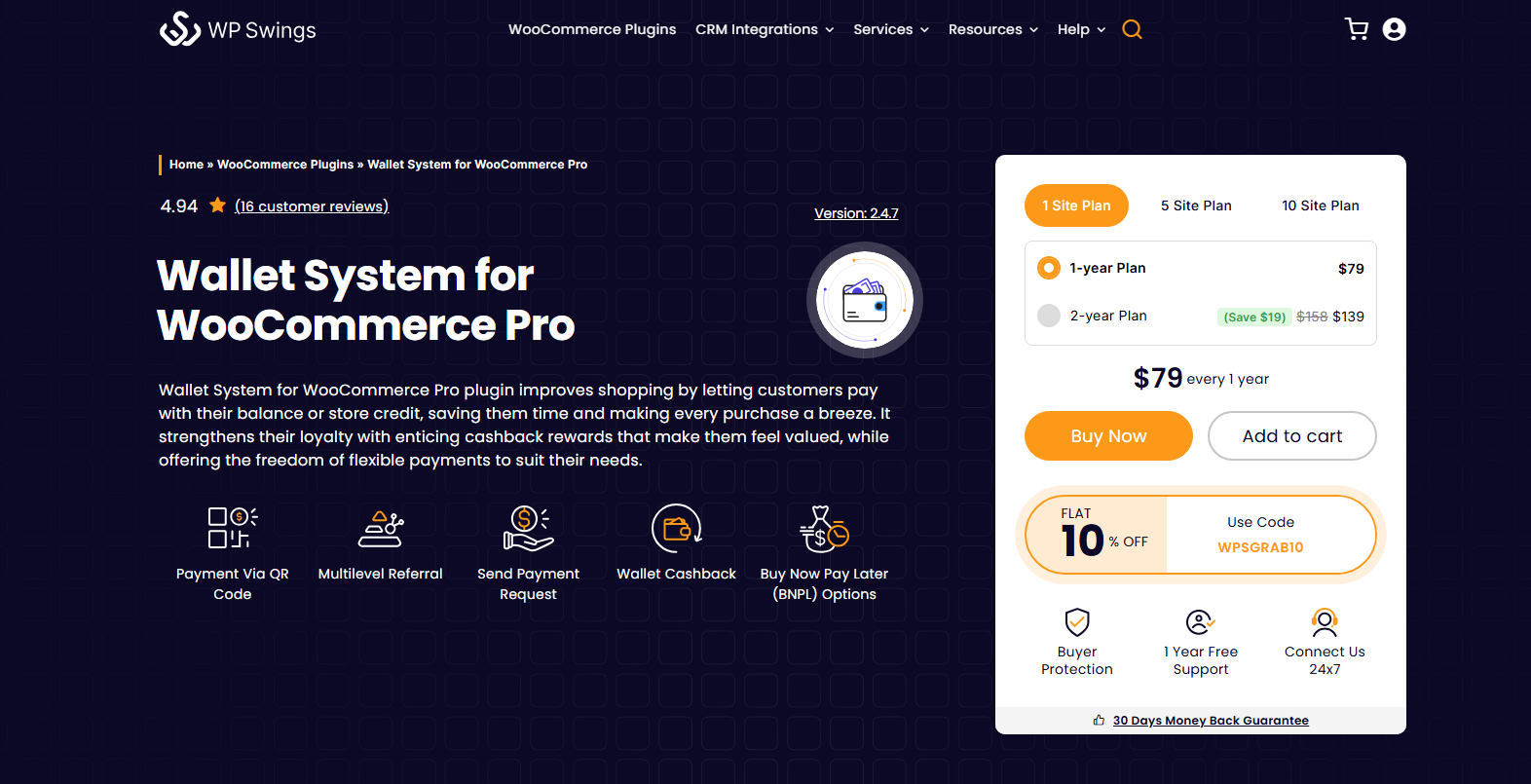
WooCommerce is one of the most widely used eCommerce platforms. Below is a quick guide on how to implement a wallet with a KYC feature in your eCommerce store.
How KYC Feature in Wallet Plugin Works
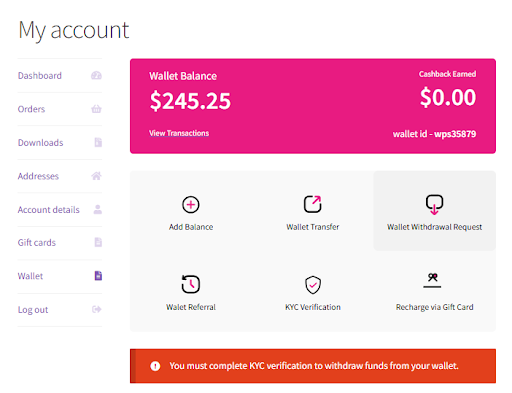
Users can easily upload the required KYC documents from their account dashboard. Store admins can decide how many documents need to be submitted and review each request before approving, rejecting, or asking for resubmission.
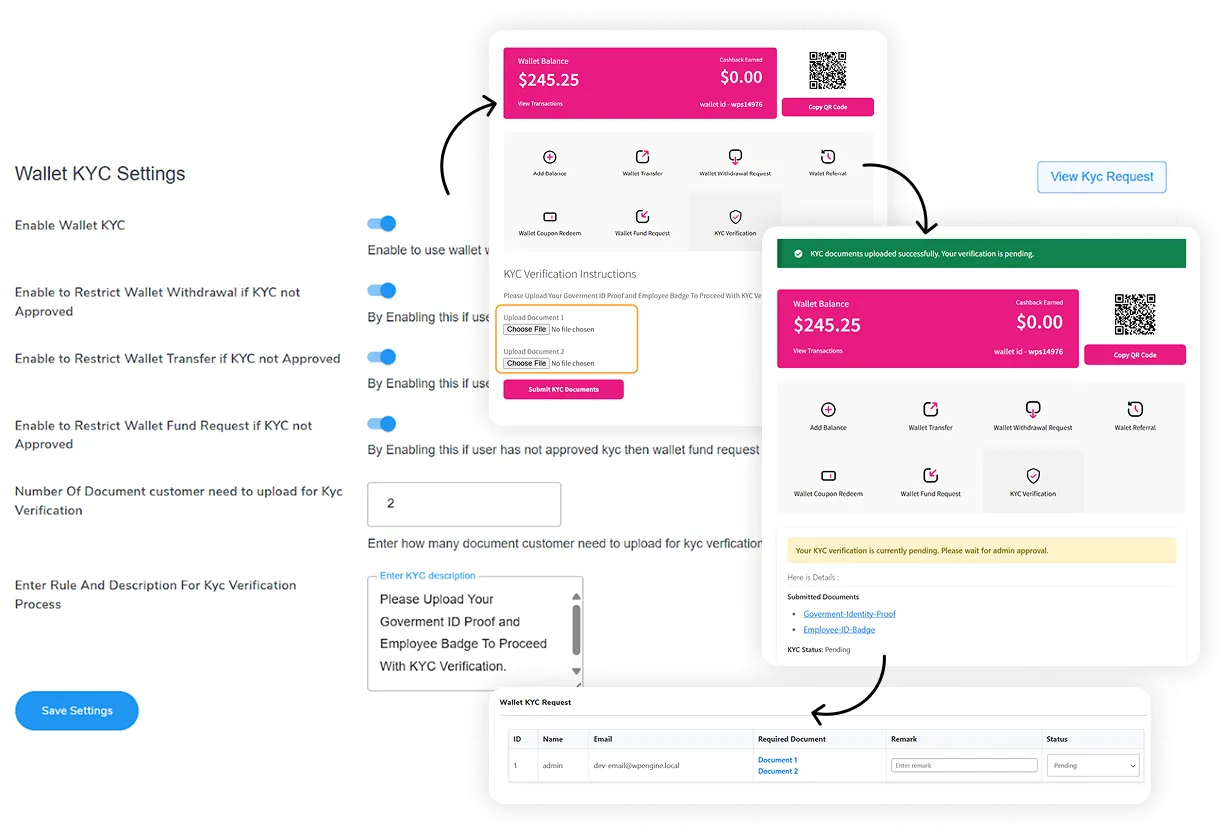
To improve security, users who have not completed their KYC verification can be restricted from wallet actions such as withdrawals, transfers, and fund requests.
You can also display a custom message on the KYC page to explain these restrictions and guide users on the documents they need to submit to complete the verification process.
Set up Wallet System for WooCommerce
Wallet System for WooCommerce is a free plugin, and it’s by far the best digital wallet for WooCommerce.
You can go to WP Swings’ WordPress.org page to download it.
- Go to WordPress Dashboard > Plugins and click Add New.
- Click the Browse button, upload the plugin, and click Install.
- Hit Activate, and you’re all set to use Wallet System For WooCommerce.
Enable The KYC Feature
Navigate to the wallet KYC tab, and there you can enable the below-listed feature as per your requirements
-
- Enable Wallet KYC: Turn this option on to enable KYC verification for wallet users.
- Restrict Wallet Withdrawals Without KYC: Users who have not completed KYC will not be able to withdraw money from their wallet.
- Restrict Wallet Transfers Without KYC: Enable this option to prevent users from transferring wallet funds until their KYC is approved.
- Restrict Fund Requests Without KYC (Premium): Users without approved KYC will not be able to request funds.
- Number of Documents Required (Premium): Choose how many documents users must upload for KYC verification. The default value is 1.
- KYC Rules and Instructions: Add a custom message to tell users what documents they need to submit and explain the KYC process. For example: “Please upload your government ID and employee badge to complete KYC verification.”
Wallet System for WooCommerce Plugin
Common Concerns About KYC in eCommerce Wallets
While Wallet KYC offers significant security and compliance benefits, many merchants worry about its impact on customer experience, costs, and adoption rates.
The good news is that most of these concerns can be addressed with a well-planned KYC strategy.
Will Wallet KYC Reduce Conversions?
Asking customers to verify their identity will create friction during the shopping process and reduce conversions. While this can happen if KYC is implemented poorly, modern verification systems allow businesses to strike a balance between security and convenience.
Clearly explaining that KYC helps protect customer funds, prevent fraud, and secure wallet balances can improve user acceptance. Although there may be a small decrease in sign-ups, the reduction in fraud, account abuse, and chargebacks often delivers far greater long-term value for the business.
Is Wallet KYC Too Expensive for Small Stores?
Modern identity verification services are often more affordable than the financial losses caused by fraud. The cost of verifying a user is typically much lower than the expenses associated with chargebacks, fraudulent transactions, payment processor penalties, and customer support efforts required to resolve disputes.
When evaluating KYC costs, merchants should consider the broader impact of fraud on their business. A handful of prevented fraud cases can often offset the cost of an entire Wallet KYC system.
Additionally, reducing fraud can help maintain a positive reputation, improve customer trust, and strengthen relationships with payment providers.
What If Users Don’t Want to Complete Wallet KYC?
Merchants can allow users to browse products and make purchases using traditional payment methods without requiring KYC. Wallet-specific features, such as storing funds, wallet top-ups, transfers, withdrawals, or higher transaction limits, can remain restricted until verification is completed.
Frequently Asked Questions (FAQs)
1. What is KYC in an eCommerce wallet system?
KYC (Know Your Customer) is a customer identity verification process used to confirm that a wallet user is who they claim to be. It typically involves verifying government-issued identification documents, selfies with liveness checks, and, in some cases, proof of address.
In an eCommerce wallet system, KYC helps businesses prevent fraud, secure wallet transactions, and ensure that only legitimate users can access wallet features such as deposits, transfers, and withdrawals.
2. Is KYC mandatory for eCommerce wallets?
The requirement for KYC depends on how the digital wallet system operates and the regulations that apply to the business.
Not every eCommerce store is subject to the same compliance obligations. However, businesses that function as Money Services Businesses (MSBs), provide prepaid access services, or engage in money transmission activities may be required to comply with customer identification and anti-money laundering (AML) regulations.
3. How does KYC prevent digital wallet fraud?
KYC helps prevent digital wallet fraud by verifying the identity of users before they can access sensitive wallet functions.
This reduces the risk of synthetic identity fraud, fake account creation, promotional abuse, and account takeover attacks. Because wallet activities are linked to verified individuals, fraudsters find it much harder to anonymously load funds, transfer balances, or withdraw money.
KYC also creates an audit trail that helps businesses detect suspicious behavior and investigate fraudulent transactions more effectively.
4. What is the best KYC flow for eCommerce stores?
A risk-based KYC approach is often the most effective solution for eCommerce businesses. Many merchants allow customers to create accounts and shop normally while triggering identity verification before the first wallet deposit, withdrawal, or when transaction limits exceed a predefined threshold.
Businesses can also implement tiered verification levels, where basic verification grants limited wallet access and full KYC unlocks higher transaction and balance limits.
For stronger security, KYC should be combined with multi-factor authentication (MFA), device fingerprinting, transaction monitoring, and fraud detection tools.
5. Which KYC providers work best for eCommerce wallets?
Several identity verification providers offer solutions designed for eCommerce businesses and digital wallets in the market.
These providers typically support identity documents, biometric verification, liveness detection, sanctions screening, and AML compliance features, helping businesses streamline customer onboarding while reducing fraud risks.
Conclusion
As digital wallets become a core part of the online shopping experience, implementing KYC is no longer just a compliance consideration—it is a strategic investment in security, trust, and long-term business growth.
KYC also helps businesses align with regulatory requirements related to customer identification, anti-money laundering (AML), and financial transaction monitoring. Beyond compliance, it serves as a trust signal that reassures customers their funds and personal information are being protected, leading to higher customer confidence and stronger brand loyalty.
For WooCommerce store owners, the Wallet System for WooCommerce plugin by WP Swings provides an easy way to implement a fully functional digital wallet on your eCommerce store.
As covered in the step-by-step setup guide above, you can integrate KYC verification into your wallet system to verify users, secure wallet transactions, prevent fraudulent activities, and create a safer experience for both customers and merchants.
About the Author: Mohd Talib







That’s a really important point about fraud prevention – it’s easy to overlook the security implications when digital wallets become so central to online shopping.