

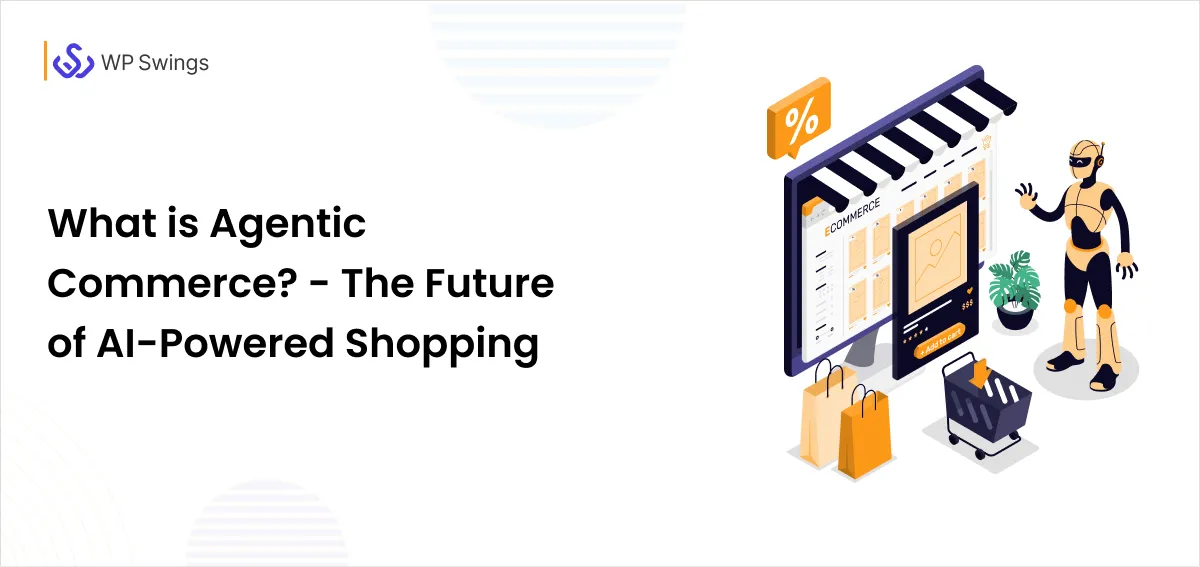
What is Agentic Commerce? This is a question that almost all eCommerce, WooCommerce, and WordPress store owners are now asking, because AI is rapidly changing the way customers shop online.
For years, online store owners have optimised their websites to meet the moving requirements of customers. But what if we say the next generation of shoppers may not browse through your store at all? They will rely on a AI Sales Agent to browse, compare, place, and track the order on their behalf.
These Agents not only understand your customers’ requirements, but also compare products across multiple stores and sometimes even complete the purchase autonomously.
In A Hurry? Here’s A Brief Summary…
- Agentic commerce is shifting retail from manual searching to intent-and-execute automation.
- The total transaction value of agentic commerce is expected to jump from $8 billion to $3.5 trillion; a 43,240% increase in value.
- eCommerce big names like Shopify are now investing in building dedicated developer architectures that allow merchants to transform catalogs into machine-readable product data for Agentic commerce tools.
- Agentic commerce is considered to be the next evolution after conversational AI because it not only answers questions but also completes tasks.
- Sellers who effectively deploy agentic commerce for their sales are 3.7 times more likely to meet their revenue targets.
- AI-powered sales platforms save sales representatives an average of 2 hours by automating post-purchase tasks such as order tracking, subscription management, and initiating returns.
- Agents can also analyze support tickets, unpaid invoices, and login drops to identify accounts at high risk of cancellation.
- Future shoppers may never take the time to visit your homepage; they’ll rely on AI agents instead to surface the most relevant products.
As the online shopping landscape continues to evolve, it becomes crucial for businesses to prepare for the change and to stay competitive. Unlike traditional AI tools that simply assist customers, agentic AI can act on their behalf. This shift is creating a new shopping experience wherein AI sales agents act as active participants in the buying journey.
What does this mean for eCommerce store owners? Rethinking how their store attracts customers and optimizing their products for AI-driven purchasing decisions.
In this blog, we will explain “what is agentic commerce”, how it works, its benefits and challenges, and how store owners can adapt to an AI-powered shopping future.
In This Blog, We Will Talk About…
(Jump to the section that interests you the most!)
What is Agentic Commerce?
So, now to finally address the question: What is Agentic Commerce? It is an AI-driven approach to eCommerce in which autonomous AI agents can understand a shopper’s intent, make decisions, and complete purchase-related tasks on their behalf.
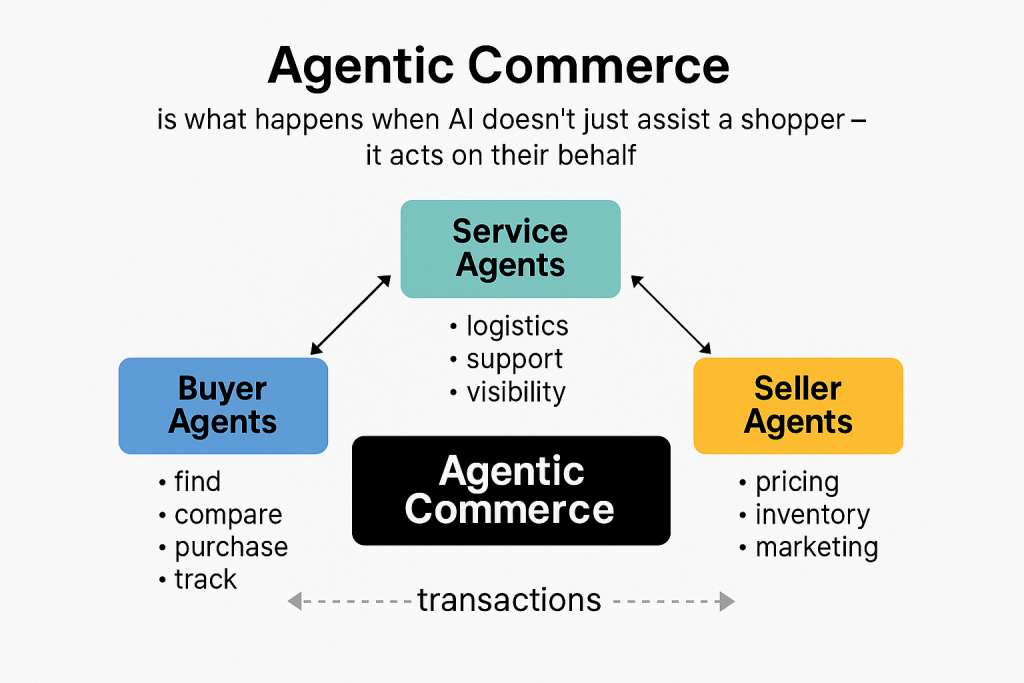
Source: WorkfxAI Blogs
Unlike traditional AI tools that just answer questions or simply recommend products, agentic AI actively searches for products, compares options, evaluates reviews, applies discounts, completes purchases, and even manages post-purchase tasks such as order tracking, reordering, refunds, or exchanges; all this without leaving the chat.
In a nutshell, agentic commerce shifts online shopping from a human-led approach to an AI-assisted shopping experience. Instead of manually browsing multiple websites, shoppers can simply tell an AI Sales agent what they need, and the agent handles the entire shopping journey based on the user’s preferences, budget, and goals. Many AI Sales Agent applications, also known as autonomous shopping assistants, also provide merchants with the functionality for smooth Agent-to-Human handoffs.
Meet CXS AI Sales Agent!!!
What does this mean for eCommerce businesses? This represents a fundamental change in how products are discovered and purchased. As AI agents become more involved in buying decisions, store owners must ensure their product data, pricing, inventory, and customer experience are optimized primarily for AI that evaluates products before making recommendations or completing transactions.
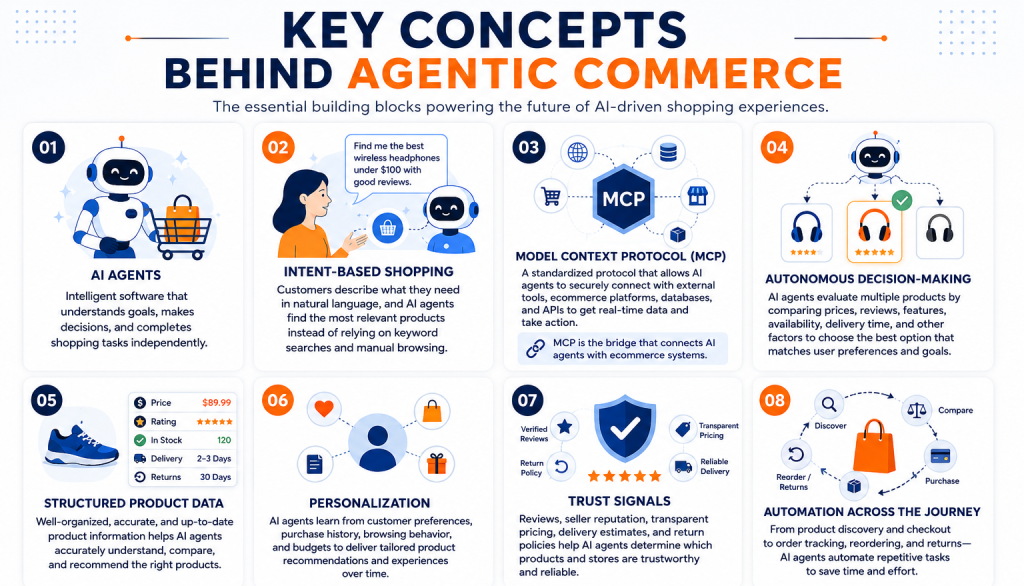
6 Key Concepts Of Agentic Commerce
If you are new to the concept of “what is agentic?” Consider this section a cheat sheet to familiarize yourself with the mental framework for understanding how this new mode of commerce actually works.
1. AI Agents
In the concept of “what is agentic commerce?” The core value of AI agents is intelligent software systems designed to perform tasks autonomously. Unlike traditional AI chatbots that only respond to prompts, AI agents can understand objectives, gather information, and make decisions. All while executing actions.
In eCommerce, an AI agent can search for products, compare alternatives, apply discounts, place orders, and even manage post-purchase activities such as managing refunds or handling loyalty programs based on a shopper’s preferences.
2. Autonomous Decision-Making
One of the defining objectives of agentic commerce is autonomous decision-making. Rather than waiting for a user/shopper to approve every step, AI agents can evaluate multiple products, compare prices, analyze reviews, and select the option that best matches predefined criteria such as budget, quality, delivery time, or brand preference.
3. Intent-Based Shopping
Traditional eCommerce relies on customers searching with keywords and manually browsing products. Agentic commerce shifts this to intent-based shopping, where shoppers simply describe what they want; let’s understand this with an example: “Find me lightweight travel shoes under $100 with good & genuine reviews.” The AI Sales Agent interprets the request and completes the shopping journey on the customer’s behalf. Managing the automated checkout flow through an autonomous checkout system.
4. Model Context Protocol (MCP)
Imagine you build an AI Sales Agent for your Shopify store,
Without a Model Context Protocol,
- AI will be able to chat with the shopper, but
- It can not access your CRM, order history, inventory, or payment system unless you build separate integrations for each.
With Model Context Protocol,
- Instead of needing to create separate integrations, it has a standardised way to connect with these systems,
- Your AI Sales Agent can –
- Verify inventory
- Analyze product catalogs
- Check customer orders
- Create a discount
- Update a CRM
- Trigger a shipping workflow
Just as USB-C connects different devices with a single standard, MCP can provide AI agents with a standard way to connect with ecommerce tools, APIs, and services.
5. Personalization
Did you know Agentic commerce goes beyond generic recommendations? How? By using customer information like their preferences, order history, purchase patterns, browsing behavior on your agentic commerce platform, and budget to personalize shopping experiences. Over time, AI Sales agents can learn a shopper’s habits and make relevant product suggestions or purchasing decisions.
6. Structured Product Data
For AI agents to make accurate purchasing decisions, they rely on structured product data: titles, specifications, product pricing, availability, customer reviews, shipping details, and return/exchange policies. The more accurate and organized this information is, the better AI agents can analyze and recommend products.
How Does Agentic Commerce Work?
The basic idea is that instead of shoppers navigating your website and comparing prices, the AI Sales Agent knows what your store offers and is equipped to handle the entire transaction.
An agent works by starting when a user requests or prompts. Unlike traditional AI systems, which give similar, one-off responses, modern agents are built to interpret these requests, consider context, adapt on the fly, and decide how to move forward or hand it over to a human agent.
Let us understand the workflow of Agentic Commerce –
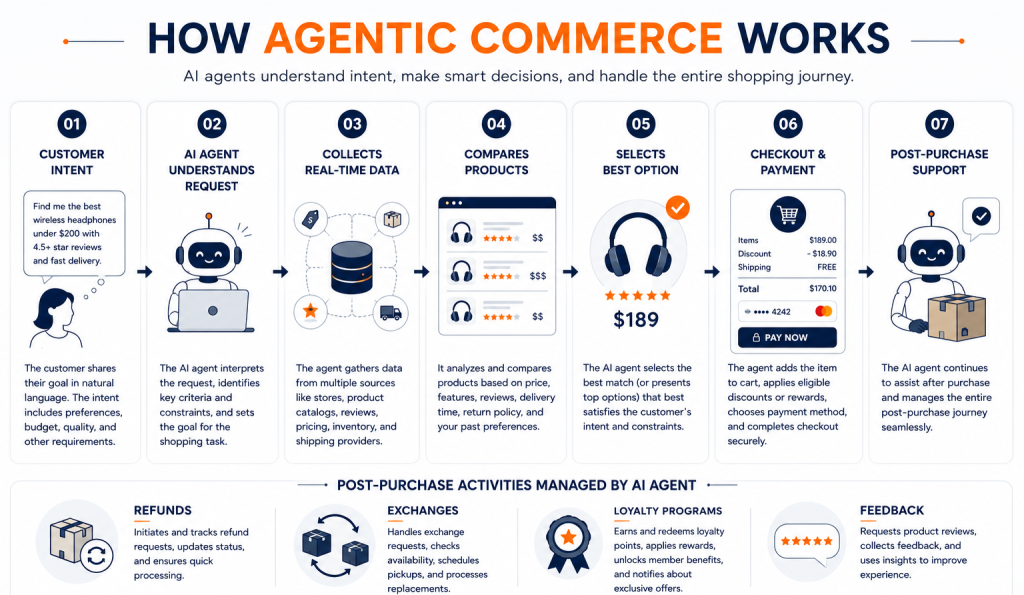
Agentic commerce operates through a specialized AI purchasing workflow where autonomous shopping assistants or AI buying agents manage the end-to-end shopping journey on behalf of a consumer. Instead of a human manually searching and checking out, the process is driven by an autonomous buying process and governed by specific technical protocols.
1. The AI Purchasing Journey
The workflow follows a structured AI transaction lifecycle that moves from product discovery to final execution:
- AI-driven Discovery and Automation: A personal shopping AI or intelligent shopping chatbot identifies products within an AI shopping ecosystem. This is the defining stage for AI shopping automation, where the agent finds the best options based on user preferences.
- Standardized Interaction: For an agent to interact with a merchant, it uses the Agentic Commerce Protocol (ACP) or an open commerce protocol. This serves as the agentic commerce standard, ensuring interoperability between different AI agents and retail platforms.
- Infrastructure Support: This interaction is supported by an AI commerce architecture that includes AI WooCommerce APIs, SDKs, and commerce orchestration tools.
2. Autonomous Payments and Checkout
A critical component of how agentic commerce works is the automated checkout flow, which handles the financial transaction without direct human intervention for every step:
- Delegated Payments: The system uses AI payment authorization and delegated payments, wherein the agent is granted the authority to execute AI financial transactions.
- Secure Execution: To maintain security, the process utilizes agentic tokenization, AI identity verification, and AI authorization to ensure the agent is a trusted entity.
- Smart Checkout: The intelligent checkout process (or agent checkout) creates a frictionless AI checkout experience, often including one-click AI checkout or conversational checkout interfaces right from the chat box.
3. Trust, Consent, and Compliance
Because agents act autonomously, the framework relies heavily on consent-driven commerce.
- Consent Management: AI consent management ensures that the agent only operates within the boundaries set by the user.
- Security and Fraud Prevention: The system incorporates AI fraud prevention and secure autonomous transactions to protect the consumer.
- Regulatory Alignment: Compliance is maintained through AI governance and adherence to GDPR, AI commerce, and AI payment regulations.
Once the shopper enters a prompt for the AI Sales Agent, the agent thereafter doesn’t just present a list of options; it also actively reasons through them based on the user’s initial parameters and its own understanding of what constitutes a good deal or best fit.
Agentic AI Vs Agentic Commerce
This is where many store owners get confused; there is a major difference between agentic AI and agentic commerce.
This comparison here will give our readers a better understanding of both concepts: “What is Agentic Commerce” vs “Agentic AI”
| Aspect | Agentic AI | Agentic Commerce |
|---|---|---|
| Definition | A type of AI that can reason, make decisions, and autonomously complete tasks to achieve a goal. | The application of Agentic AI within ecommerce to automate and optimize the shopping journey. |
| Primary Purpose | Enable AI systems to perform complex tasks with minimal human intervention. | Improve how customers discover, evaluate, purchase, and manage products using AI agents. |
| Scope | Broad; applicable across industries such as healthcare, finance, manufacturing, customer support, and software development. | Specific to retail and ecommerce, focusing on buying, selling, and post-purchase experiences. |
| Focus | Intelligent decision-making and task execution. | Autonomous shopping, personalized recommendations, and commerce automation. |
| Typical Tasks | Scheduling meetings, writing code, analyzing data, automating workflows, managing customer support, and planning actions. | Finding products, comparing prices, applying discounts, placing orders, tracking shipments, handling returns, and managing subscriptions. |
| Users | Businesses, developers, and professionals across multiple industries. | Online shoppers, ecommerce merchants, retailers, and marketplaces. |
| Data Sources | Enterprise systems, APIs, databases, productivity tools, CRMs, and business applications. | Product catalogs, inventory systems, customer profiles, pricing engines, reviews, payment gateways, and shipping providers. |
| Outcome | Increased productivity, automation, and operational efficiency. | Faster, more personalized shopping experiences and improved ecommerce conversions. |
| Examples | An AI agent that automates project management or resolves IT support tickets. | An AI shopping agent that finds the best product, applies coupons, completes checkout, and tracks delivery. |
Where Can I Use Agentic Commerce Today?
If you have reached this section of our blog post, you are well aware of the “what is agentic commerce”, key concepts, how it works, and agentic commerce vs agentic AI. In this section, we will walk you through the implementation of Agentic Commerce in today’s shopping landscape.
Although fully autonomous shopping is still in its early stages of testing, store owners don’t have to wait to start benefiting from agentic commerce. Many of its core functionalities are already available through AI-powered sales agents that help customers discover products, answer questions, and make purchase decisions more efficiently.
Here are some practical ways you can put agentic commerce into action today.
1. AI Personalized Product Recommendations
Instead of showing the same generic recommendations to every shopper, AI sales agents understand customer intent and suggest products and services based on preferences, budget, purchase goals, and browsing behavior. This creates a more relevant shopping experience, helping customers find the right products faster.
2. Instant Shopping Assistance 24/7
Shoppers often have questions before making a purchase. An AI sales agent can provide instant answers about product specifications, compatibility, pricing, availability, shipping, and even return policies. This keeps shoppers engaged even outside business hours.
3. Simplify Product Discovery
Finding the right product shouldn’t require browsing dozens of pages. Customers can describe what they need in natural language, and the AI agent narrows down the options by understanding their intent, making product discovery faster and more intuitive.
4. Reduce Cart Abandonment
Many shoppers leave because they’re uncertain about sizing, product suitability, or shipping details. AI agents can proactively address these concerns, answer queries in real time, and guide customers towards a successful purchase, reducing cart abandonment.
5. Seamless Human Handoff
While AI can handle a wide range of customer interactions, some situations require a human touch. Many AI Sales Agents can seamlessly transfer conversations to support or sales teams when needed, preserving the conversation context so customers don’t have to repeat themselves. This creates a frictionless experience while ensuring complex queries are resolved efficiently.
Ready to Experience Agentic Commerce in Action?
Frequently Asked Questions
1. What is the definition and meaning of agentic commerce?
To address the question: What is Agentic Commerce? It is an AI-driven approach to eCommerce in which autonomous AI agents can understand a shopper’s intent, make decisions, and complete purchase-related tasks on their behalf.
2. How does agentic commerce differ from traditional eCommerce?
There is one key difference between agentic commerce and traditional eCommerce: who does the work? There is a shift seen in responsibility. The new-age shoppers rely on an AI Sales Agent to browse, compare, place, and track the order on their behalf.
3. Is agentic commerce compliant with privacy regulations?
No, agentic commerce isn’t automatically compliant with any privacy regulations. It solely depends on which AI Agent you build or deploy, because regulations like GDPR and CCPA require human-centric consent.
4. What are the primary business benefits of AI commerce?
The primary benefits of AI Commerce are –
- Hyper-personalised marketing
- Autonomous Inventory Management
- 24/7 Instant Customer Support
- AI-powered product recommendations and discoveries
5. What does the future of digital commerce look like in 2026?
In 2026. Digital commerce has transformed from manual-led browsing to a shopping ecosystem dominated by autonomous AI agents and fully integrated social and payment platforms.
The growing rise of AI agents executing purchases natively on behalf of humans will be the highlight of 2026 digital commerce.
About the Author: Muskaan Sabarwal