


If you have ever looked into growing an online business or making money online, you must have come across digital marketing vs affiliate marketing. The terms are often used interchangeably, which adds to the confusion. At a glance, both involve promoting products or services online, using content, traffic, and persuasion to drive results.
Reality is that while they share some common tactics, their goals, structure, and level of control are very different. Digital marketing is a broad skill set used by businesses, brands, and professionals to grow online. Affiliate marketing, on the other hand, is a specific model that focuses on earning commissions by promoting other people’s products.
Key Takeaways:
- Digital marketing is a skill set, while affiliate marketing is a business model focused on earning commissions by promoting third-party products.
- Digital marketing offers greater control, flexibility, and long-term stability, whereas affiliate marketing relies heavily on external platforms and programs.
- Affiliate marketing is easier to start with low upfront investment, but scaling it effectively requires strong digital marketing skills like SEO and analytics.
- Income models differ significantly; digital marketing can provide predictable earnings through jobs or clients, while affiliate income fluctuates with traffic and conversions.
- The most sustainable approach is combining both by learning digital marketing first and applying those skills to affiliate marketing services.
Understanding this difference matters, especially if you are deciding where to invest your time, effort, or money. In this guide, we will break down digital marketing vs affiliate marketing in clear, practical terms. You will learn when each approach makes sense, how they can work together, and how to choose the path that aligns best with your goals and experience level.
What Is Affiliate Marketing?
Affiliate marketing is about promoting someone else’s product or service and earning a commission when a sale or action takes place through your referral.
- You do not create the product.
- You do not handle payments, delivery, or support.
- Your main job is to bring the right audience and convince them to make a purchase.
Here’s a simple example: You write a blog post reviewing a tool. You add your affiliate link. If someone clicks that link and buys the tool, you earn a commission.
Affiliate marketing works best when:
- You have an audience or traffic source
- You are good at recommendations and trust-based content
- You prefer low upfront costs
What Is Digital Marketing?
Digital marketing is much broader. It covers all online marketing activities used to promote a business, brand, or product. To succeed here, you need to stay updated on the current market dynamics and global advertising trends that are shaping consumer behavior today
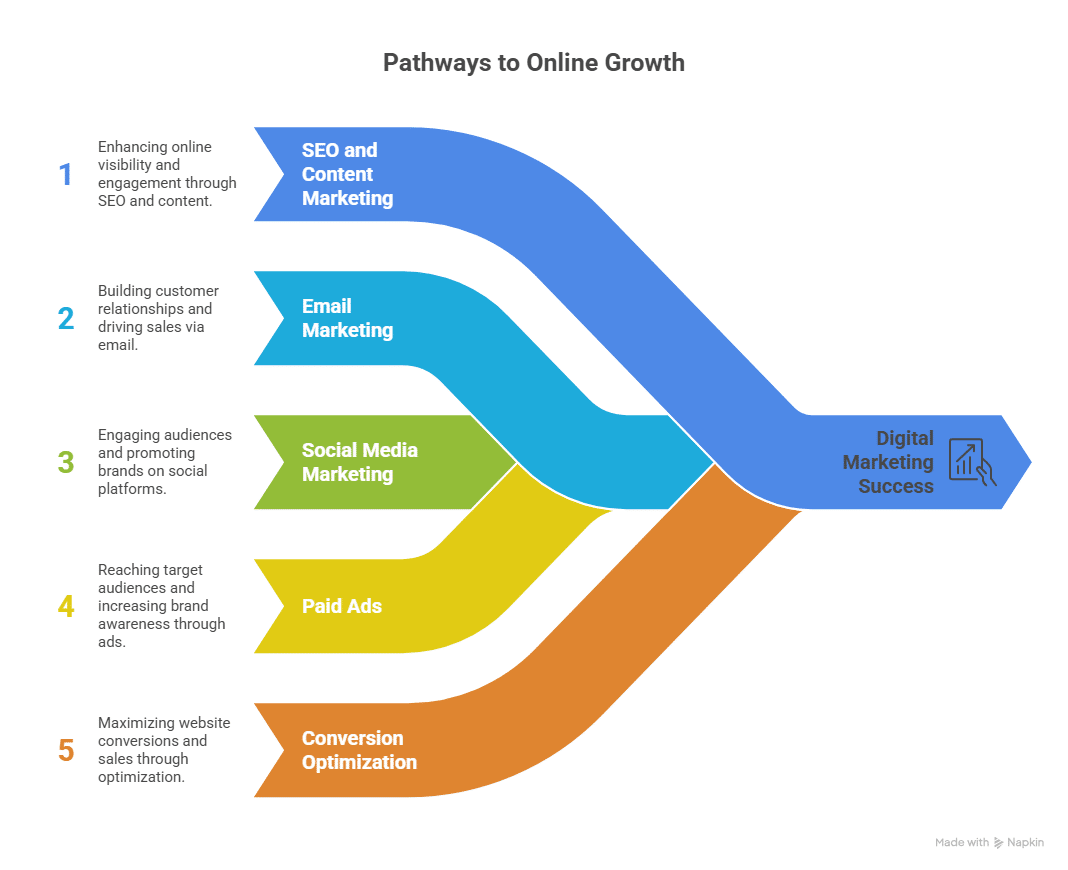
This includes:
- SEO and content marketing
- Email marketing
- Social media marketing
- Paid ads
- Conversion optimization
Digital marketing is often used by businesses to grow their own products or digital marketing agency services, but it can also be used by freelancers, agencies, and creators.
Digital marketing is a skill set. For beginners, enrolling in a digital marketing course can provide structured learning and hands-on practice. Affiliate marketing is one way those skills are applied.
Key Differences – Digital Marketing vs Affiliate Marketing
Digital marketing vs affiliate marketing may look similar on the surface, but they work in different ways and suit different goals. Knowing how they differ helps you decide where to invest your time and effort, especially if you are just starting.
1. Ownership and Control
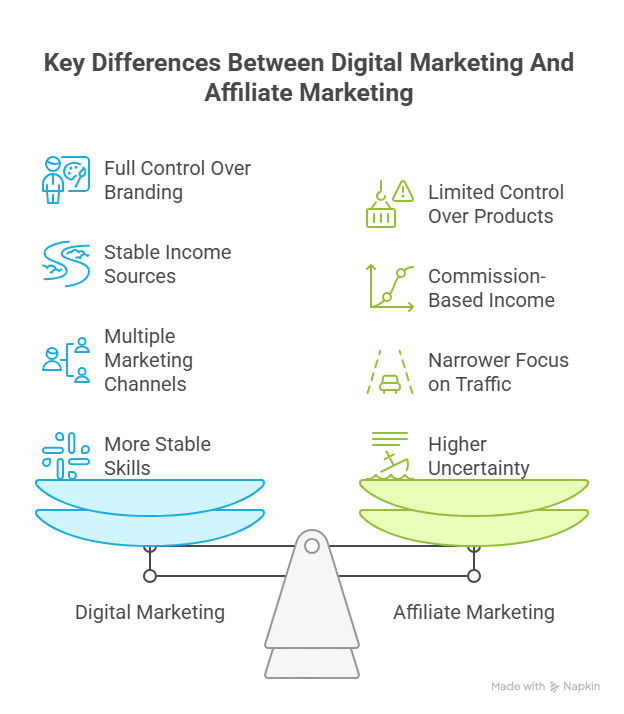
With digital marketing, you usually promote your own business or manage marketing for a client. This means you have control over branding, pricing, customer communication, and long-term strategy. You can test ideas, adjust campaigns, and build assets that belong to you or your client. That structure also makes it well-suited for white label arrangements — a white label ad agency, for instance, delivers the full scope of paid advertising work while the client-facing brand takes ownership of the results
In affiliate marketing, you promote third-party products, so control is limited. You follow the merchant’s rules, use their sales pages, and depend on their tracking and payouts.
2. Income Model
Digital marketing income often comes from fixed sources like salaries, monthly retainers, or direct product sales, while partnering with a White Label Digital Marketing Agency can create an additional revenue stream by allowing businesses to offer expanded services without increasing in-house resources.. Over time, this can become more stable and predictable.
Affiliate marketing services work on commissions, which means income depends on clicks, conversions, and commission rates. A good month can be followed by a slow one, especially if traffic drops or offers change.
3. Scope of Work
Digital marketing involves multiple channels such as SEO, content marketing, email campaigns, social media, and paid ads. The goal is usually long-term growth and brand visibility.
Affiliate marketing services have a narrower focus, mainly on driving traffic and convincing users to take action. While the work can be simpler, it often relies heavily on strong content and traffic strategies.
4. Risk and Stability
Digital marketing is generally more stable because the skills can be applied across different industries and roles. Even if one project ends, the skills remain valuable, allowing professionals to transition between sectors such as retail, technology, healthcare, or manufacturing marketing without losing career momentum.
Affiliate marketing services carry more uncertainty since you rely on external platforms and programs. Changes in commission rates, policies, or even search engine updates can directly affect earnings.
5. Learning Curve
Digital marketing has a steeper learning curve because it covers many tools, platforms, and strategies. A structured digital marketing course can make the learning process much easier for beginners. However, once learned, these skills offer flexibility and long-term value.
Affiliate marketing is easier to enter and requires less upfront investment. That said, scaling affiliate income usually means learning digital marketing skills anyway, especially SEO, analytics, and paid promotion.
When to Choose Digital Marketing or Affiliate Marketing
Choose digital marketing if:
- You want a long-term career skill
- You plan to build your own brand or agency
- You enjoy strategy, analytics, and experimentation
Choose affiliate marketing if:
- You want to start with a low investment
- You prefer content and promotion over operations
- You want flexibility without managing products
There is no rule saying you must pick only one. Many people start with affiliate marketing and later move into full digital marketing roles.
We’ve Got an Affiliate Program Too! Sign in and Start Earning…
Applying Affiliate and Digital Marketing Strategies in Practice
Affiliate marketing and digital marketing are most effective when they are applied with a clear plan, not as isolated tactics. In real-world use, successful marketers often blend both approaches to build traffic, trust, and consistent results.
- One of the most common practical applications is content-driven promotion. Digital marketing principles like SEO, search intent, and content structure are used to create blogs, landing pages, and videos. Affiliate marketing services fit into this by placing relevant affiliate links within genuinely helpful content. The focus is not on pushing links, but on solving a problem and offering a product as a natural next step.
- Another key area is traffic generation. Digital marketing provides multiple channels such as organic search, social media, email lists, and paid ads. Affiliate marketers who rely on only one traffic source often struggle to scale. Using digital marketing strategies allows you to diversify traffic, test what works best, and reduce dependency on a single platform or algorithm. Short-form video platforms have become a major traffic source. Many creators now use an Instagram reel generator, or video ad maker to test multiple content ideas quickly and drive traffic to blogs, landing pages, and affiliate offers. As the sheer volume of these media files grows, evaluating your DAM ROI can help you decide when it makes financial sense to upgrade how you organize and store your creative library
- Email marketing is another practical example of how both strategies work together. Digital marketing helps you build and segment an email list, while affiliate marketing provides offers to share with that audience. Instead of sending constant promotions, experienced marketers mix educational content with relevant affiliate recommendations. This builds trust and improves long-term performance. Tools on the market help marketers analyze audience behavior and optimize email campaigns, improving relevance and long-term performance
- Data and optimization also play a major role in applying these strategies effectively. Digital marketing tools, particularly robust marketing attribution software, help track user behavior, traffic sources, and complex conversion paths across multiple channels. Affiliate marketing benefits from this data by identifying which content, links, or campaigns perform best. Small improvements in click-through rates or page structure can make a noticeable difference over time.
- Finally, scaling and experimentation bring both approaches together. Digital marketing skills allow you to test new channels, refine messaging, and optimize funnels. As traffic and campaigns grow, the people side becomes harder to manage too, especially when marketing teams are juggling content, ads, email, and reporting at the same time. Productivity management software helps by giving teams a clearer view of task ownership, timelines, and workflow bottlenecks, so execution stays organized while strategies scale. Affiliate marketing gives you the flexibility to test multiple offers without creating products yourself. When used together, you can quickly validate ideas, drop what does not work, and double down on strategies that show real results.
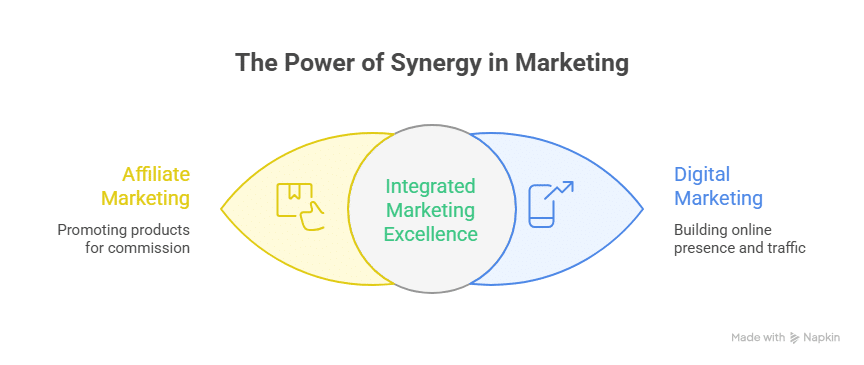
In practice, affiliate marketing becomes far more effective when backed by solid digital marketing fundamentals. Instead of choosing one over the other, applying them together creates a more balanced and sustainable approach.
Choosing Between Digital Marketing vs Affiliate Marketing: Which One Should You Choose?
Choosing between digital marketing vs affiliate marketing is less about which option is better and more about what you want to achieve. Both paths can be effective, but they serve different purposes and require different levels of involvement and control.
If you are looking to build a long-term career or business, digital marketing is a stronger foundation. The skills you develop can be applied across industries, roles, and projects.
You can work with clients, grow your own brand, or even create and sell your own products. Over time, this approach offers more stability and flexibility.
Affiliate marketing is a good choice if you want a faster and lower-risk entry into online earning. It works well for people who enjoy content creation, niche research, and promotion without handling products or customer support. However, it also comes with less control and more dependency on external platforms and programs.
In most cases, the best choice is not one or the other. Digital marketing gives you the skills, and affiliate marketing gives you a way to monetize those skills. When combined, they create a practical and balanced approach that allows you to test ideas, build traffic, and grow income more sustainably.
If you are unsure where to start, learn digital marketing first. Once you understand how traffic, content, and conversion work, affiliate marketing becomes easier and far more effective. Many beginners also work with a marketing analytics agency to better understand campaign performance, audience behavior, and which channels are generating the strongest results over time.
With this being said, we’ll wrap up this article, but don’t worry if you still have some questions. Below are some of the most frequently asked questions that will help you out, and if you don’t find your solution here, you can also reach out to us in the comments section.
Get Huge Festive Discounts on WP Swings Plugins
Frequently Asked Questions (FAQ’s)
1. What Does a Digital Marketer Do?
A digital marketer promotes a business or brand online. Their work usually includes creating content, improving search visibility, running ads, managing email campaigns, and tracking performance. The goal is to attract the right audience and turn that interest into leads or customers using online channels.
2. How Much Does Digital Marketing Cost?
The cost of digital marketing depends on the approach. It can range from very low to quite high. For example, organic methods like SEO and content mainly cost time and tools, while paid ads require a clear budget. Partnering with the Best SEO Outsourcing Company can help businesses balance cost and performance by creating strategies that maximize long-term online visibility and ROI. Small businesses may start with a few thousand per month, while larger campaigns can scale much higher based on goals and competition.
3. How to Generate Leads in Digital Marketing?
Lead generation in digital marketing usually starts with understanding your audience and offering value.
Common methods include content marketing, SEO, landing pages, email signups, and paid ads. Many businesses also use conversational channels for lead generation, especially when they want to turn high-intent traffic into direct customer conversations. Leveraging a guestpost marketplace can also help expand brand visibility, attract relevant audiences, and generate qualified leads through targeted content placements. The key is to attract users with useful information and guide them toward a clear action like filling a form or subscribing.
4. Is Affiliate Marketing Legit?
Yes, affiliate marketing is legit. It is a well-established business model used by major companies and creators worldwide. As long as you work with genuine affiliate programs and focus on honest promotion, it is a valid way to earn online.
5. Is Affiliate Marketing Worth It?
Affiliate marketing can be worth it, but it is not quick money. It works best for people who are patient and consistent. Results usually come from building traffic and trust over time. For those willing to learn and test, it can become a reliable income stream.
6. How to Pick a Niche for Affiliate Marketing?
Choosing a niche starts with finding a balance between interest, demand, and earning potential. Pick a topic you understand or are willing to learn, check if people are actively searching for solutions, and make sure there are relevant affiliate products available. A focused niche is often better than a broad one.
About the Author: Mohd Talib




Saved as a favorite, I really like your blog!
Hello! I found this comparison helpful because it finally made it clear to me how digital marketing and affiliate marketing actually differ in practice — I used to mix them up all the time, but now it feels way easier to see where each one fits in real work.
Informative comparison of digital marketing and affiliate marketing — clear and insightful for anyone exploring marketing strategies. For more expert guidance and digital solutions, visit DreamsSoftTechnology.
A really good blog and me back again.