

Launching a Shopify store with print-on-demand is one of the easiest ways to start an online business without upfront inventory.
The best print-on-demand apps for Shopify handle printing, packing, and shipping for you – so you can focus on designing products and marketing your brand. In this 2026 guide, we’ll compare the top POD services (from industry giants to niche specialists) to help you find the right fit for your store.
We’ll rank 12 of the best print-on-demand Shopify apps and break down their product selection, quality, shipping speeds, pricing models, and more. Whether you prioritize premium quality, fast fulfillment, global reach, or unique merchandise, there’s an option here that can support your business needs. Before diving into the detailed reviews, use the quick-reference table below to scan the standout features of each POD app.
We’ll then go through each app one-by-one, followed by a decision guide on key criteria, some pro tips for success, and an FAQ section. Let’s get started!
| Print-on-Demand App | Key Strengths | Main Product Focus | Best For |
|---|---|---|---|
| Podbase (Free) | 24-hour printing; high profit margins | Tech accessories (phone, laptop & gadget cases) | Fast fulfillment in tech/gadget niches |
| Printful (Free + optional plan) | Premium quality; branding & warehousing | Wide catalog (apparel, home, accessories) | Building a branded, high-quality product line |
| Printify (Free + optional plan) | Huge supplier network; low base costs | Very broad (apparel, decor, etc. via 90+ partners) | Maximizing variety and profit margins |
| Gelato (Free + optional plan) | Local production in 30+ countries; great for EU/US | Mixed catalog (apparel, wall art, paper goods) | Reaching global customers with faster shipping |
| Gooten (Free) | Automation & scalability; API integrations | Broad catalog (via global network) | Tech-savvy or high-volume sellers (multi-channel) |
| CustomCat (Free + optional plan) | Bulk discounts; 2–3 day US fulfillment | Apparel, athletic wear, merch items | U.S.-focused stores aiming for low costs at scale |
| Teelaunch (Free) | Unique products (home goods, gadgets); reliable fulfillment | Apparel + niche items (pet beds, electronics, etc.) | Adding unusual items to complement core products |
| Teelaunch (Free) | Unique products (home goods, gadgets); reliable fulfillment | Apparel + niche items (pet beds, electronics, etc.) | Adding unusual items to complement core products |
| SPOD (Spreadshirt) (Free) | Fastest production (48-hour avg); easy to use | Apparel, wall art, accessories (limited range) | Quick turnaround for U.S./EU orders, new sellers |
| AOP+ (Free + optional plan) | All-over-print & eco-friendly production | Apparel (AOP shirts, leggings, etc.) | Sustainable brands or custom pattern designs |
| JetPrint (Free) | Niche items (watches, sneakers); 3D mockups | Watches, footwear, and novel accessories | Offering unique products beyond standard POD fare |
| Apliiq (Free + optional plan) | Fashion-forward apparel; true private labeling | Premium clothing (streetwear, cut-and-sew) | Building a custom clothing brand with branding |
| ShineOn (Free) | High-margin jewelry & gift items | Personalized jewelry, keepsakes | Gift product sellers (occasions, upsells for any store) |
(Free = no monthly fee; “optional plan” indicates a paid upgrade for discounts or features. All apps are available via the Shopify App Store.)
12 Best Print on Demand Apps for Shopify (2026)
Each of the Shopify POD apps below has earned its spot by excelling in certain areas. Remember, there’s no single “best” for everyone – it depends on your product strategy and priorities. Many successful store owners actually use a combination of POD services (e.g., one generalist plus one or two niche specialists) to cover all their bases.
With that in mind, let’s explore the top contenders and what makes each one stand out:
1. Podbase — Best overall for tech accessories + fast fulfillment

Podbase is a strong pick if your Shopify store is built around tech accessories and you care about speed. It’s designed for merchants who want quick turnaround times and a clean workflow for launching device-related products.
It’s not trying to be an everything-store POD platform. Instead, it wins by specializing and making the experience fast and simple, which can be ideal for stores targeting phone-case-style impulse buys and higher-margin accessories.
- Best For: Tech accessory brands, phone case stores, gadget niches
- Catalog Focus: Phone cases and tech accessories (specialized rather than broad)
- Fulfillment: Fast production on core items, built around quick dispatch
- Shipping Coverage: Strong fit for stores selling in the US and Europe
- Branding: Options such as pack-ins or branded touches, depending on the product
- Pricing Model: Typically free to install, pay per order
- Watch-outs: Limited apparel/home goods selection, so many stores pair it with a general POD app
2. Printful — Best for premium quality and brand control
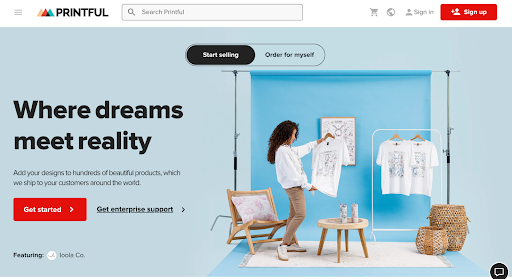
Printful is often the go-to if you want your products to feel more “retail-grade.” It’s a popular choice for brand builders because it tends to be consistent and supports a more polished customer experience.
If your strategy is to charge premium prices, build repeat buyers, and invest in brand perception, Printful’s stronger quality control and branding features can justify its higher base costs.
- Best For: Premium brands, creators who care about consistency, long-term stores
- Catalog Focus: Broad mix of apparel, accessories, home goods
- Fulfillment: Reliable production timelines across multiple locations
- Branding: Pack-ins, packing slip branding, and select labeling options
- Workflow: Strong mockups and product setup experience
- Pricing Model: Free to start, optional plan for discounts/perks
- Watch-outs: Higher base prices can reduce margins unless you price accordingly
3. Printify — Best for variety and supplier flexibility

Printify works like a marketplace of print providers, which gives you more control over product cost, fulfillment location, and selection. That flexibility makes it a favorite for sellers who want to experiment with many product types or optimize margins.
Because quality can vary between providers, the smartest approach is to standardize on a small set of suppliers you trust, then build your catalog around them after sample testing.
- Best For: Large catalogs, margin optimization, testing product ideas quickly
- Catalog Focus: Very broad selection across many categories
- Fulfillment: Depends on the chosen print provider and location
- Shipping Coverage: Often strong because you can pick providers near customers
- Branding: Usually lighter than premium-first platforms
- Pricing Model: Free tier plus optional subscription for bigger product discounts
- Watch-outs: Quality consistency varies by print provider, and sample testing matters
4. Gelato — Best for global reach with local production

Gelato is built for sellers who want to ship internationally without everything traveling from one country. Its model routes orders to production closer to the buyer, which can reduce shipping time and cost in many regions.
This makes Gelato a particularly strong choice if you expect orders from multiple countries or you’re building a brand with a meaningful EU customer base.
- Best for: International stores, EU-heavy audiences, globally distributed buyers
- Catalog Focus: Core POD staples like apparel and print products
- Fulfillment: Local production approach in multiple regions
- Shipping Coverage: Strong for cross-border selling, especially in Europe
- Branding: Solid basics, varies by product type
- Pricing Model: Free start, optional subscription for discounts/features
- Watch-outs: Not always the widest catalog for niche items
5. Gooten — Best for scalable operations and automation

Gooten is more operationally focused than design-tool focused. It’s often chosen by sellers who care about scalable systems, automation, and smooth fulfillment performance once volume grows.
If you’re planning a bigger catalog, multi-channel expansion, or a more technical workflow, Gooten can be a dependable backbone once set up properly.
- Best For: Scaling brands, operational efficiency, advanced workflows
- Catalog Focus: Broad, network-based product selection
- Fulfillment: Automated routing and backend efficiency focus
- Shipping Coverage: Global network approach
- Branding: Generally limited compared with brand-first providers
- Pricing Model: Usually pay per order, no required subscription
- Watch-outs: Less beginner-friendly and less “pretty” in setup experience
6. CustomCat — Best for U.S. apparel speed and cost

CustomCat is a strong choice for U.S.-focused apparel sellers who want competitive base pricing and fast production timelines. It’s often used by stores that run promotions, sell at higher volume, or need consistent turnaround in the U.S.
If your buyers are mostly American and your catalog leans heavily toward tees and hoodies, it can be a practical profit-first option.
- Best For: U.S. apparel brands, high-volume sellers, promo-driven stores
- Catalog Focus: Apparel-heavy, plus some accessories and home products
- Fulfillment: Fast production for many U.S. orders
- Shipping Coverage: Best for U.S. customers; international shipments can be slower
- Branding: Generally minimal compared with premium providers
- Pricing Model: Free, start with an optional plan for steeper discounts
- Watch-outs: Interface and tooling can feel less modern than competitors
7. Teelaunch — Best for unique product add-ons

Teelaunch is a useful way to add product variety beyond the standard POD basics. Many sellers use it to complement a primary provider because it can offer niche items that help a store stand out.
It’s best approached as a catalog-extender: keep your core items on your main POD platform, then use Teelaunch for the “interesting extras” that create differentiation.
- Best For: Stores wanting niche products alongside standard apparel
- Catalog Focus: Mix of standard POD plus unusual giftable items
- Fulfillment: Reliable, typical POD production timelines
- Shipping Coverage: Stronger in core markets like the U.S. and select regions
- Branding: Mostly standard fulfillment presentation
- Pricing Model: Pay per order, no required subscription
- Watch-outs: Not the deepest toolset for branding or premium packaging
8. SPOD (Spreadconnect) — Best for fastest production turnaround

SPOD is widely known for speed. If you’re selling products tied to trends, events, or time-sensitive campaigns, faster production can reduce cancellations and support tickets. It’s also straightforward to use, which makes it attractive for beginners who want to launch quickly with a smaller set of proven products.
- Best For: Fast fulfillment needs, trend-based sellers, simple apparel stores
- Catalog Focus: Apparel and a smaller mix of accessories and prints
- Fulfillment: Extremely fast production compared with many POD apps
- Shipping Coverage: Strong in the U.S. and Europe
- Branding: Typically limited compared with brand-first platforms
- Pricing Model: Generally, pay per order, no subscription required
- Watch-outs: Smaller catalog and fewer branding enhancements
9. AOP+ — Best for all-over print and ethical positioning

AOP+ is ideal if your brand relies on bold, full-coverage designs or you want a stronger sustainability story. It’s especially relevant for fashion-forward stores that need all-over print products rather than standard chest prints.
Because its specialty products can take longer to produce, it’s best for customers who value uniqueness over next-day delivery.
- Best For: All-over print apparel brands, pattern-heavy designs, eco-minded positioning
- Catalog Focus: All-over print apparel and select lifestyle items
- Fulfillment: Often slower due to specialty production
- Shipping Coverage: Strongest for the UK and Europe; global shipping varies
- Branding: Some options depending on plan/product
- Pricing Model: Free start, optional plan for perks/discounts
- Watch-outs: Not the best fit if your priority is fastest global shipping
10. JetPrint — Best for watches, shoes, and standout niche items

JetPrint is worth considering if you want products that don’t look like typical POD catalogs. Watches and footwear can create a “wow factor” that helps you stand out, and they can support higher retail pricing.
The tradeoff is that specialty items and international fulfillment can mean longer delivery windows, so clear shipping expectations are essential.
- Best for: Unique catalogs, gift stores, premium-priced novelty products
- Catalog Focus: Watches, footwear, specialty accessories
- Fulfillment: Variable; often longer than standard apparel POD
- Shipping Coverage: International shipping with longer transit times
- Branding: Minimal packaging customization
- Pricing Model: Pay per order
- Watch-outs: Longer delivery times; product positioning must match that reality
11. Apliiq — Best for private-label apparel and fashion brands

Apliiq is built for sellers who want their apparel to feel like a real clothing label. It’s one of the best choices for branding-heavy fashion because it offers customization that goes beyond printing a design on a blank.
If your goal is a streetwear or boutique clothing brand and you’re willing to pay more for that private-label feel, Apliiq is a strong fit.
- Best for: Streetwear, premium apparel brands, private-label experience
- Catalog Focus: Apparel and fashion-forward products
- Fulfillment: Often longer than basic POD due to extra customization steps
- Shipping Coverage: Strong for U.S. customers; global shipping varies
- Branding: Labels, patches, embroidery, and other brand-building options
- Pricing Model: Free start, optional membership for pricing/perks
- Watch-outs: Higher costs and longer production are common with premium customization
12. ShineOn — Best for personalized jewelry and gift margins

ShineOn is a specialist platform for personalized jewelry and sentimental gift products. It’s popular because jewelry and gift items can support higher perceived value and stronger margins compared to standard POD apparel.
This is a great add-on to almost any store: even if you mainly sell clothing, a gift collection can increase average order value and seasonal sales.
- Best for: Gift stores, holiday campaigns, sentimental niches, upsells
- Catalog focus: Jewelry and giftable accessories
- Fulfillment: Generally fast for the U.S. and select regions
- Shipping coverage: Strong in key markets; global options vary by product
- Branding: Gift presentation is central, but packaging customization is limited
- Pricing model: Pay per order
- Watch-outs: Narrow catalog, best used alongside a general POD provider
How to Choose the Best Print on Demand App for Your Shopify Store
With so many quality POD apps available, how do you decide which one(s) to use? Here are some key decision criteria to weigh when evaluating print-on-demand suppliers for Shopify:
1. Product Quality & Consistency
The success of your custom products hinges on print quality and item durability. Look for providers known for consistent, high-resolution printing and good materials so that what you design online matches what customers receive.
Reading reviews and ordering sample products is wise before you fully commit to any platform. For instance, Podbase is praised for reliably excellent prints, whereas a marketplace like Printify can vary by print provider (hence, test a sample from each provider you plan to use). Quality also extends to garment fabric (are the shirts soft, does the apparel fit true to size?) and print techniques (DTG vs. screenprint vs. sublimation) – these impact customer satisfaction.
2. Fulfillment Speed
In the age of Amazon Prime, customers value quick delivery. POD naturally has some lead time for production, but top services will clearly communicate their average fulfillment times (e.g., “ships in 2-4 days”).
Faster production and shipping can reduce customer anxiety and complaints. Apps like Podbase excel in speed (often printing within 24 hours), while others might take a week or more for complex items. Consider how important fast dispatch is for your niche. If you sell trending or time-sensitive merch, speed might make or break a sale. Also, check if the app offers expedited shipping options or production upgrades for a fee.
3. Shipping Locations & Coverage
Where are your customers? Choose a POD app with production facilities in or near those regions. Local production means quicker, cheaper shipping and fewer customs issues.
Printify and Gooten allow you to route orders to printers on different continents. Gelato specializes in local-global fulfillment across 30 countries. If you primarily sell in one country, a provider with a factory in that country (or at least on the same continent) is ideal. On the other hand, if you’re truly global, you might use a mix of apps to cover various regions (for example, Printful for North America/Europe and a China-based supplier for Asia/Australia). Also, check shipping rates – some apps might have higher shipping fees that eat into your margins.
4. Catalog Range vs. Niche Focus
Evaluate the product catalog of each app. Do they carry the types of products you want to sell? Some apps (Printify, Printful) offer 300+ product types covering almost everything – great for variety, but maybe overwhelming if you only need a specific category.
Others are niche specialists (ShineOn for jewelry, Apliiq for fashion apparel, Podbase for tech accessories). There’s no harm in using multiple apps to play to each one’s strength. Most serious POD brands use 2–4 providers in parallel to cover different product types or regions. If you’re starting, decide if you want a “one-stop-shop” for simplicity or if you’re willing to juggle a couple of apps to get the best of each (it’s easier than it sounds, since Shopify will manage orders across apps).
Also consider the unique products an app offers that competitors don’t – those could be your winning differentiation.
5. Branding Options
Your brand identity can help you stand out from just generic print products., and consider tools like an AI enabled template builder that help you create personalized designs and branding assets more efficiently throughout your customer experience. Podbase allows branded pack-ins and labels, Apliiq specializes in private labels, whereas many network-based apps (Printify, Gooten) have limited branding options.
Some apps also include sneaky branding like their logo on the packing slip – not ideal if you want a white-label experience. Check if the app allows you to use your own logo on packing slips or if they have a white-label shipping policy. A well-branded order (with your logo and messaging) can create a more memorable unboxing experience and increase repeat business, so it’s a factor if you’re building a long-term brand.
Pro Tip: There’s no rule that you must stick to only one POD app. In fact, many successful Shopify stores mix and match POD providers to optimize for the best each has to offer.
For example, you might use Printful for its embroidered hats and mugs (high quality), Printify for cheap t-shirts through a particular print partner, and ShineOn to add a jewelry line for Valentine’s Day.
Your customer won’t know the difference; they’ll just see more products and get their orders reliably. Shopify will treat each app’s orders separately in the backend, but it’s generally seamless for you to manage.
Tips For Succeeding With Print On Demand on Shopify
Using POD apps makes life easier, but success still requires strategic effort. Here are some tips to get the most out of your print-on-demand Shopify business:
1. Order Samples and Test Products
Always order sample products from each POD supplier you use before selling to customers. This helps you verify print quality, see the actual colors, test the product durability (wash a sample shirt, wear the jewelry, etc.), and photograph your own lifestyle images if needed. It’s a small investment that can save you headaches down the line. Plus, you’ll have physical products for creating marketing content!
2. Optimize Your Design Files
High-quality prints start with high-quality artwork files. Follow each app’s guidelines for resolution, color profile, and file format. If designing apparel, consider using the largest print dimensions available so your design looks crisp. Also, take advantage of mockup generators to create attractive product images – these tools (provided by Podbase, Printify, etc.) can help your products look professional on your site. Great visuals can significantly boost your conversion rates.
3. Set Realistic Shipping Expectations
Be transparent with customers about production and shipping times. Since POD isn’t instant, avoid over-promising. Display estimated delivery times on product pages or during checkout (e.g., “Printed and shipped in 3-5 days”). If using multiple POD suppliers, remember that shipping times might differ – for instance, a SPOD product may arrive sooner than one from JetPrint. Consider adding an FAQ on your store about how your products are made to order, which can actually be a selling point (“freshly printed just for you”). Managing expectations leads to happier customers and fewer “Where is my order?” inquiries.
4. Offer Niche and Seasonal Products
One advantage of print-on-demand is that you can easily add or remove products to capitalize on trends. Use this to your advantage by testing new niches or seasonal items. For example, list some ugly Christmas sweaters in Q4 via a POD app, or create a limited-edition design for a trending meme. Since there’s no inventory risk, you can experiment with new designs or product types and see what resonates. If something flops, you can simply unpublish it. If something takes off, you’ve found a new revenue stream. Keep an eye on POD product news too – providers often release new products (like when Printful added all-over print swimwear or when ShineOn added new jewelry types), which you can be early to market with.
5. Use Multiple POD Apps Strategically
As mentioned earlier, don’t be afraid to combine apps to play to their strengths. You might start with one, but as you grow, diversify. This not only expands your product range but also provides backup options. If one supplier has a stock shortage or holiday slowdown, you can route orders to another if you have similar products set up. It also allows you to source the best price for each item. Just keep your Shopify products organized – you may have two similar products (one from App A, one from App B), and you’ll want to ensure you fulfill the correct one when an order comes in. Thankfully, Shopify’s order details will specify which app’s product was ordered, making it straightforward.
Frequently Asked Questions (FAQ)
1. Can I use multiple print-on-demand apps in one Shopify store?
Yes – Shopify fully supports using several POD apps simultaneously. In your Shopify admin, you can install multiple POD app integrations (like Podbase, Printify, Printful, etc.). When you create products, you’ll just choose which app to create them through. Many merchants do this to take advantage of each app’s strengths or unique products.
2. Are print-on-demand apps free to use?
Almost all POD apps for Shopify are free to install and have no monthly fee on the basic plan. You can design and list products for free; you only pay the production and shipping costs when a customer orders an item (the charge is deducted after the order comes in). This is what makes POD such a low-risk business model – there’s no upfront inventory cost. That said, many apps offer premium subscriptions with perks.
For instance, Printify Premium ( ~$29/month ) gives you up to 20% off product-based costs, and CustomCat’s $30/month plan cuts prices significantly. These are optional, but can improve your profit margins if your sales volume is high enough.
3. Which print-on-demand app has the best print quality?
It’s hard to crown a single “best quality” app, as quality can vary by product type. However, Podbase is often lauded for consistently high print quality and premium materials – they control their own production and have strict QA, so their prints on tech accessories are top-notch. Apliiq also delivers excellent quality, especially for apparel, because they focus on fashion and quality control for each piece.
4. What is the fastest print-on-demand app in terms of shipping?
Podbase is arguably the fastest POD fulfillment service – they print 95% of orders within 24 hours, meaning your item often ships out in 1-2 days. Many users report surprisingly quick deliveries with SPOD, especially in the US and EU, where their facilities are located. Printful can also be fast for certain items if shipped from a facility near the customer (they have an “express” network for some products). Gelato can be very fast internationally by routing to local printers (often cutting delivery down significantly vs. shipping globally). CustomCat often ships in 2-3 days for US orders due to its focus on efficiency. If a customer is in Europe, a Europe-based POD like T-Pop or Inkthreadable (UK) could be quickest because of the short distance. But in general, SPOD’s 48-hour production promise is hard to beat for speed. Just remember, actual delivery time = production time + shipping transit.
5. How can I ensure product quality and avoid issues with POD orders?
Quality control in POD requires a proactive approach since you don’t handle the product yourself. Here are a few tips:
- As mentioned, order samples from each supplier and inspect them – this helps you choose the best print provider if using a networked app like Printify.
- Use high-quality design files and follow each app’s guidelines (this prevents errors like blurry prints or misaligned graphics).
- If color accuracy is crucial (say for artwork prints), order a test print because colors can print differently than they appear on screen.
- Pay attention to sizing charts and product specs provided by the app – ensure you display those to customers to get the right fit and expectations.
6. Is print-on-demand still profitable in 2026?
Absolutely – print on demand can be profitable in 2026, but as with any business, success depends on execution. The POD market has gotten more competitive (many people have jumped in over the past few years), so simply slapping a generic design on a shirt might not make you rich. The sellers who profit are those who find winning niches or create compelling designs/brands that resonate with a specific audience.
The good news is that POD technology and options have improved: you have more products to sell, better quality, and the same low-risk model. To maximize profitability, pay attention to your costs (use the right supplier for the right product), and price your items appropriately by highlighting their value (e.g., a unique design, personal message, or premium quality).
About the Author: Muskaan Sabarwal